My work is concerned with the decent of the ordinary human and how acceptance of a single injustice cascades into its normalization. The conventional narrative attributes historical tragedies, as a top down function driven by evil leaders whose ideas proliferate downwards to society. However, ordinary people must participate to set up the conditions for tragedies to exist.
As a cosmopolitan woman from India, I refuse to conform to societal constructs which breach the basic needs of human rights. There are two major issues which made my works take a turn because I couldn’t help but see the consequences all around me, on my return to India during the break.
Violent and brutal rape is an Indian pandemic with cases doubling in the last 17 years. Most cases of sexual assault go unreported therefore statistics can be misleading. However, the National Crime Records Bureau’s 2017 report stated that in 93% of cases, victims were raped by their grandfather, father, husband, brother, son and acquaintances. 90 women are raped every day and the victims are aged between 3 months to 80 years. There is not a single woman whom I truly know who has not been sexually or physically abused. A disgraceful but true fact for women in India.
Second, the implementation of new laws such as the CAA and NRC which discriminates against muslims – marking the first step towards a Hindu nation
The Citizenship (Amendment) Act, 2019 was passed by the Parliament of India on the 11 December 2019. It amended the Citizenship Act of 1955 by providing a path to Indian citizenship for illegal migrants of Hindu, Sikh, Buddhist, Jain, Parsi and Christian ‘the religious minorities’ from Pakistan, Bangladesh and Afghanistan who had fled their country because of religious persecution from Pakistan, Bangladesh and Afghanistan, who came to India on or before 31st of December 2014. Muslims from those countries were not given such eligibility even though 14% of India’s population is Muslim. This is the first time India has created criteria on the basis of religion which has resulted in a lot of hate crimes within the country
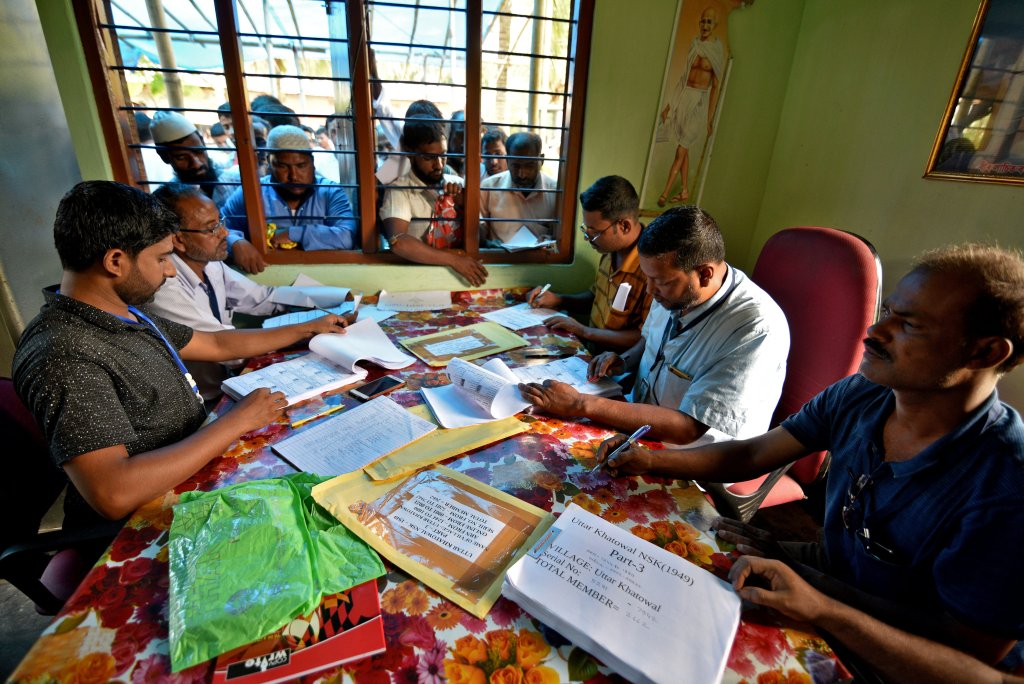
People wait to check their names on the draft list at the National Register of Citizens (NRC) centre at a village in Nagaon district, Assam state, India, July 30, 2018. REUTERS/Stringer
In response to the above law, I created a ‘Lakshman Rekha’ between Muslims and the other religions stated in the Act. In Hindu mythology, a ‘Lakshman Rekha’ was drawn to protect the good from the evil. I have tried to commentate on how Indians are creating divisions between themselves on the basis of religion. I didn’t give them faces because if you strip them of their religion they wouldn’t create the differences among them.
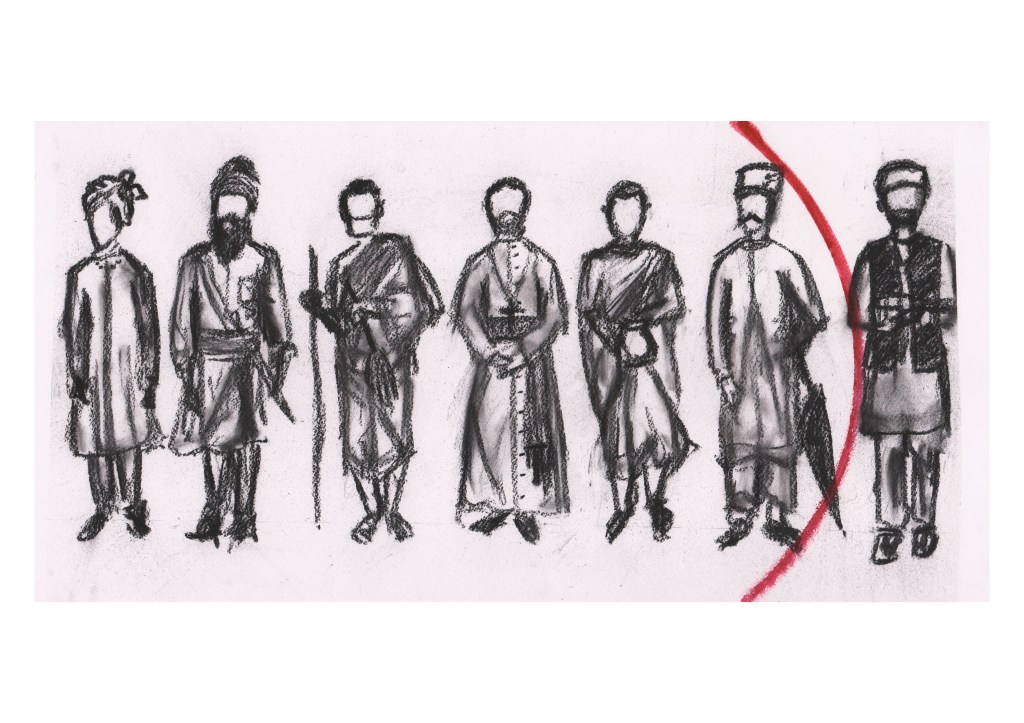
Lakshman Rekha, 2019; Charcoal and Red Sindoor
This ‘Lakshman Rekha’ or the ‘line of control’ was originally drawn during the Partition of India on the day of our ‘Independence’. This ‘line of blood’ was drawn by Cyril Radcliff, a british lawyer , to two independent nation states: Hindu-majority India and Muslim-majority Pakistan. Immediately, there began one of the greatest migrations in human history, as millions of Muslims trekked to West and East Pakistan (the latter now known as Bangladesh) while millions of Hindus and Sikhs headed in the opposite direction. Many hundreds of thousands never made it.
Partition displaced fifteen million people and killed more than a million through massacres, arson, forced conversions, mass abductions, and savage sexual violence. Some seventy-five thousand women were raped, and many of them were then disfigured or dismembered.
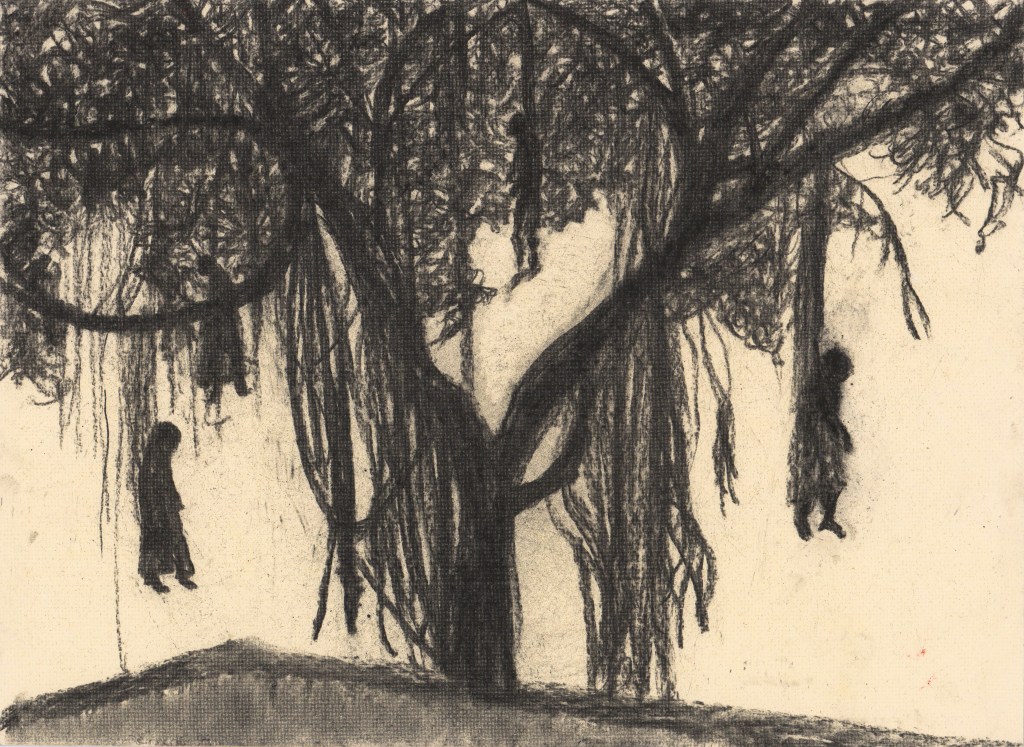
The Banyan Tree, 2019; Charcoal
From the mass killings during the partition, till even today in the rural parts of India, women are lynched after brutal rape. Their bodies swaying from the Banyan tree. The same Banyan tree they swung on as a child. The same banyan tree women fast and gather around, praying for the long and healthy lives of their husbands.
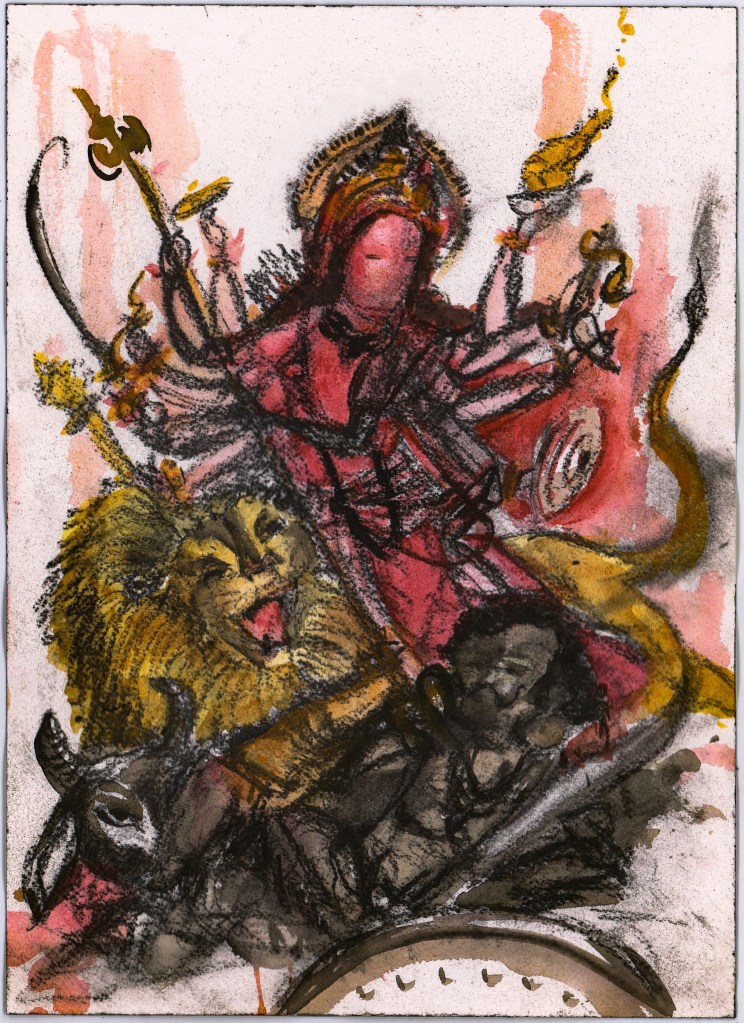
Shakti, 2019; Charcoal, Red Sindoor and Turmeric
In Hinduism, the goddess Durga, is the protective mother of the universe. She is one of the principal forms of Shakti, ‘the divine female energy’ in the Hindu religion. Durga is the warrior goddess. As such, she is willing to unleash her vengeance in order to combat evil and demonic forces that threaten peace and prosperity. Goddess Durga represents the power of the Supreme Being that preserves moral order and righteousness in the creation. In Sanskrit, Durga means “a fort” or “a place that is difficult to overrun.”
I wanted to show the juxtaposition between idealism and reality of life for women in India. Violent and brutal rape is led by the “dominance” of men in the patriarchal society. Yet, in Hindu tradition, people deck Goddesses up with jewelry and pray to them for a prosperous future every day.
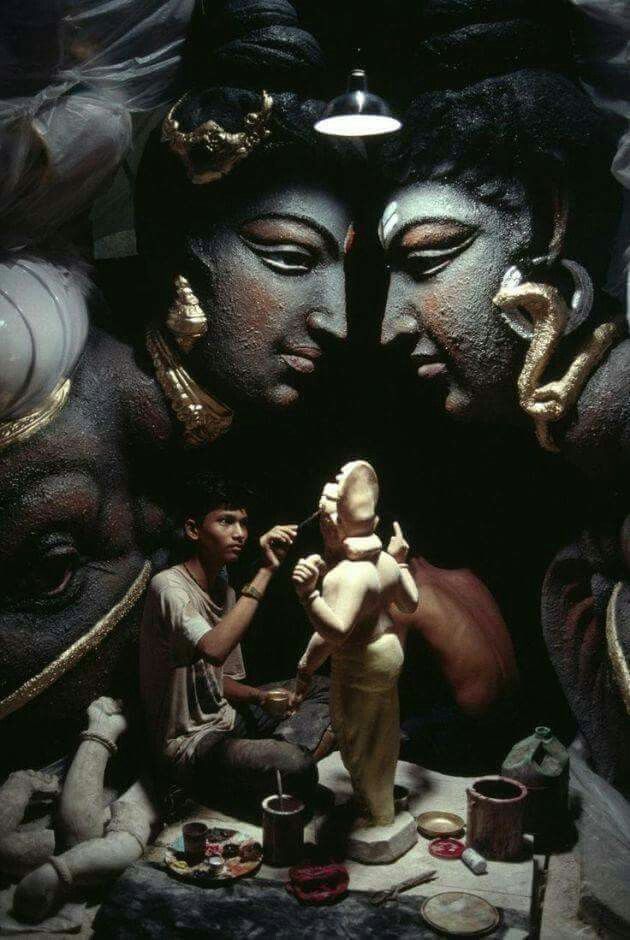
Young boy makes a Durga idol for Durga Ashtami in Bengal, Steve McCurry
I hope one day the powers of the humanity overcome the powers of religion. When a woman can adopt the same identity as Durga.
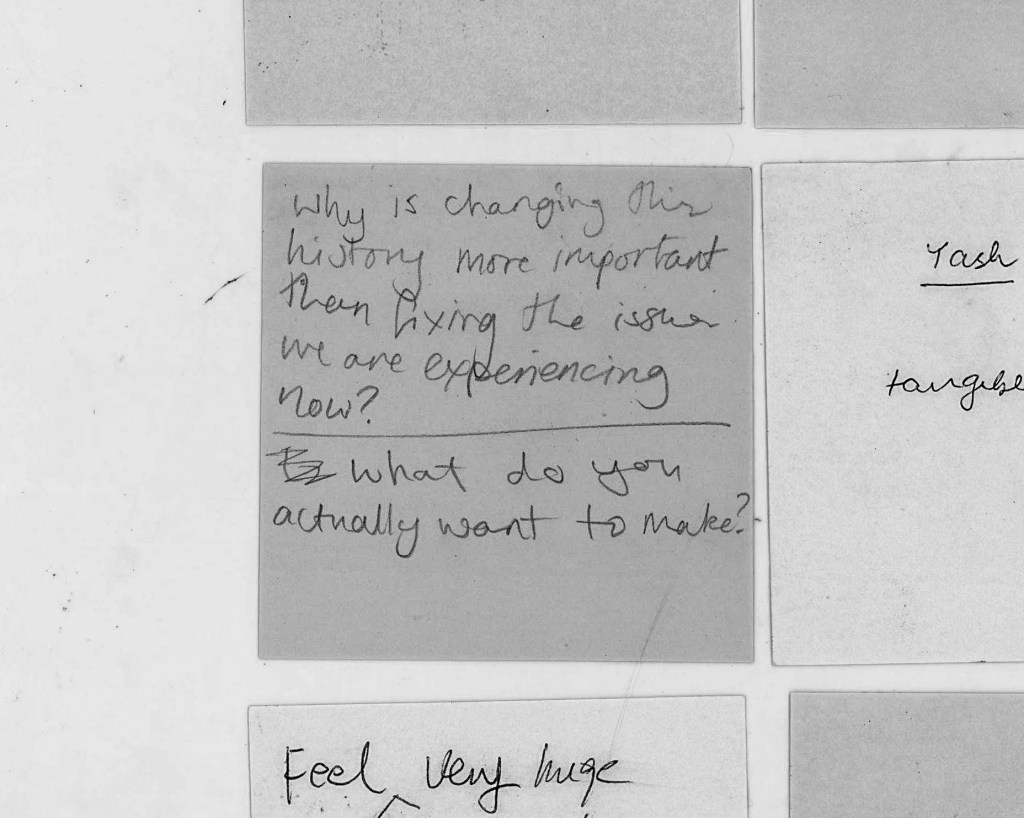
The post-it note left on my Statement of Intent chart which gave me a new deeper sense of direction and purpose within the context of my work and what I wanted to achieve
 Yash's Blog